How Many Steps Is 30 Minutes on the Elliptical
The number of steps in 30 minutes on an elliptical varies widely, typically between 3,000 and 6,000 steps, depending entirely on your machine’s stride length and your personal pace. Unlike walking, where a step is a clear footfall, an elliptical “step” is a full pedal revolution, making direct comparisons to a pedometer inaccurate. Focus on your machine’s metrics, workout intensity, and time rather than trying to hit a specific step count for fitness results.
Key Takeaways
- Elliptical “steps” are not walking steps: One elliptical step equals one full pedal revolution, which is a different motion and distance than a natural walking step.
- Stride length is the #1 factor: Your machine’s preset stride length (e.g., 20″ vs. 18″) dramatically changes how many revolutions (steps) you complete in 30 minutes.
- Your pace and resistance matter: A faster, more intense workout with higher resistance will yield more steps than a slow, easy recovery session in the same time.
- Use your elliptical’s display: The most accurate step count for your specific workout is the one recorded by your machine’s console; don’t rely on generic online calculators.
- Don’t chase a walking step goal: Comparing your elliptical steps to a 10,000-step walking goal is misleading. Focus on time, perceived exertion, and calories burned on the elliptical itself.
- Calorie burn is a better metric: For weight loss and cardio fitness, tracking calories burned or heart rate zones during your elliptical session is far more useful than counting steps.
- Consistency is key: Regular 30-minute sessions, regardless of the exact step count, will build endurance, strengthen muscles, and improve cardiovascular health.
📑 Table of Contents
- Why the Question “How Many Steps?” is Trickier Than You Think
- How the Elliptical Works: Decoding Stride Length and Resistance
- The Calculation: Estimating Your 30-Minute Step Count
- Elliptical Steps vs. Walking Steps: Why the Comparison is Flawed
- What You Should *Really* Track on the Elliptical (Instead of Steps)
- How to Maximize Your 30-Minute Elliptical Workout for Real Results
- The Bottom Line: Stop Counting, Start Achieving
Why the Question “How Many Steps?” is Trickier Than You Think
You’ve just finished a solid 30-minute session on your trusty elliptical. You’re sweaty, you feel great, and you check the console. It proudly displays a number: maybe 4,500. “Great!” you think, “That’s almost half my 10,000-step goal!” But wait. Is that 4,500 *really* comparable to the 4,500 steps you’d get from a brisk walk around the neighborhood? The short, frustrating answer is: not really. The concept of a “step” on an elliptical is fundamentally different from a step on solid ground. This isn’t just fitness semantics; it’s about understanding what your body is actually doing and how to measure a truly effective workout. Before we dive into ranges and calculations, we need to dismantle the core misconception. A “step” on an elliptical is a full 360-degree revolution of the pedal. Your foot travels in a smooth, elongated oval, pushing forward and backward. A walking step is a heel strike, a weight shift, and a push-off. The muscle engagement, the range of motion, and the distance traveled per “step” are not equivalent. So, when we ask “how many steps is 30 minutes on the elliptical,” we’re asking about pedal revolutions, not footsteps. This crucial distinction is why you can’t simply add your elliptical steps to your Fitbit’s daily total and expect it to mean the same thing.
How the Elliptical Works: Decoding Stride Length and Resistance
To estimate your step count, you must first understand the two primary mechanical factors at play on your machine: stride length and resistance. Think of stride length as the “gearing” of your elliptical. It’s the manufacturer-set distance your foot travels from the front-most point of the pedal’s path to the back-most point. Common residential elliptical stride lengths range from 14 inches (compact, for smaller spaces) to 20 or even 21 inches (for a more natural, long gait). A longer stride length means each revolution covers more “ground” and will naturally result in fewer revolutions (steps) over the same period compared to a shorter stride length, assuming your pace (RPMs) is the same.

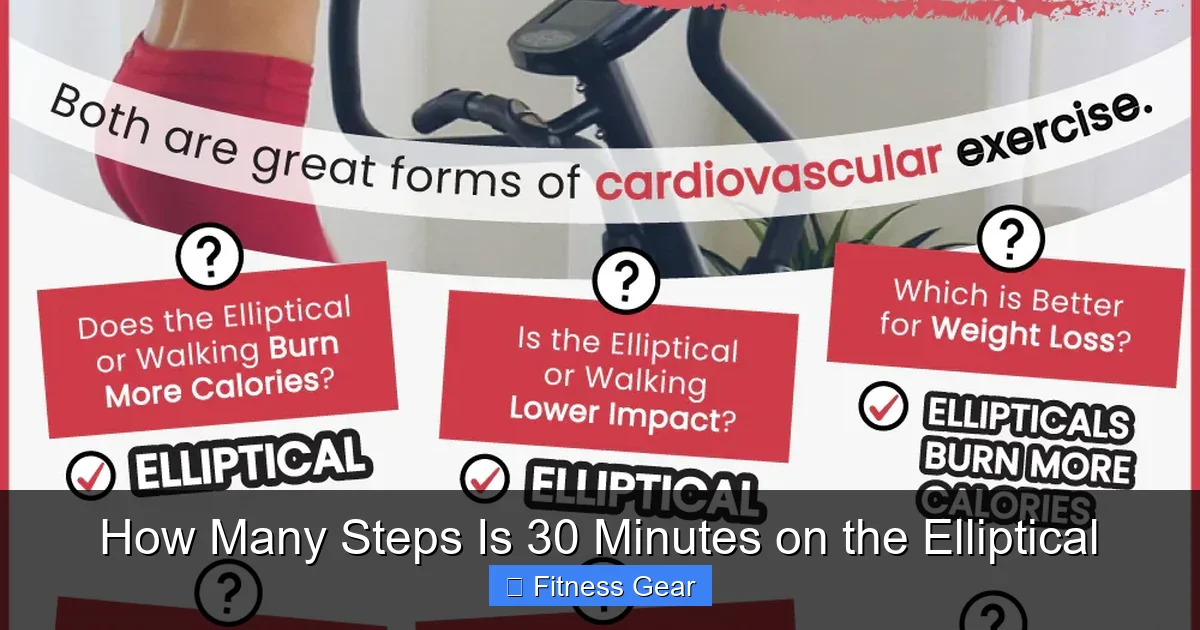
Visual guide about How Many Steps Is 30 Minutes on the Elliptical
Image source: fitdominium.com
The Role of Resistance and Your Personal Pace (RPMs)
Resistance is the other half of the equation. Crank up the resistance knob or level, and you’re making it harder to push the pedals through their arc. What happens? To maintain the same *speed* (measured in RPMs, or revolutions per minute), you have to exert more force. But most people, when they increase resistance, naturally slow their pace. They push harder but with fewer, slower revolutions. Therefore, a high-resistance, strength-focused workout will have a lower step count than a low-resistance, cardio-focused “speed” session at the same time interval. Your personal pace—how fast you choose to move your legs—is the final variable. Two people on identical machines at the same resistance will have different step counts if one is pushing for 80 RPMs and the other is cruising at 60 RPMs.
The Calculation: Estimating Your 30-Minute Step Count
Now for the math. The formula is beautifully simple: Total Steps = Strides per Minute (your pace/RPM) x 30 minutes x 1 (since 1 revolution = 1 elliptical step). The challenge is knowing your average RPM. Unless your elliptical console displays real-time RPM (many do), you’ll need to estimate or measure it. Here’s a practical guide based on common stride lengths and typical user paces:

Visual guide about How Many Steps Is 30 Minutes on the Elliptical
Image source: fitdominium.com
- Short Stride (14-16 inches): Users often have a naturally higher cadence. A moderate pace might be 70-80 RPMs. Estimated 30-min steps: 2,100 – 2,400. A very fast, low-resistance pace could hit 90+ RPMs, pushing toward 2,700+ steps.
- Standard Stride (18-20 inches): This is the most common. A comfortable, sustainable pace for many is 60-70 RPMs. Estimated 30-min steps: 1,800 – 2,100. A vigorous pace (75-85 RPMs) at low-to-moderate resistance could reach 2,250 – 2,550 steps.
- Long Stride (20+ inches): Mimics a longer, more powerful running gait. The cadence is often lower. A good pace is 50-65 RPMs. Estimated 30-min steps: 1,500 – 1,950. Even with high effort, the stride length keeps the revolution count lower.
Practical Tip: The best way to get your *personal* number is to do a 5-minute test. Set your elliptical to a comfortable, sustainable resistance. Note the “Steps” or “Revolutions” reading at the start. After 5 minutes, check it again. Subtract the start number, then multiply that 5-minute total by 6. That’s your estimated 30-minute step count for that specific machine and that specific effort level. Do this at different resistance levels to see the variance.
Elliptical Steps vs. Walking Steps: Why the Comparison is Flawed
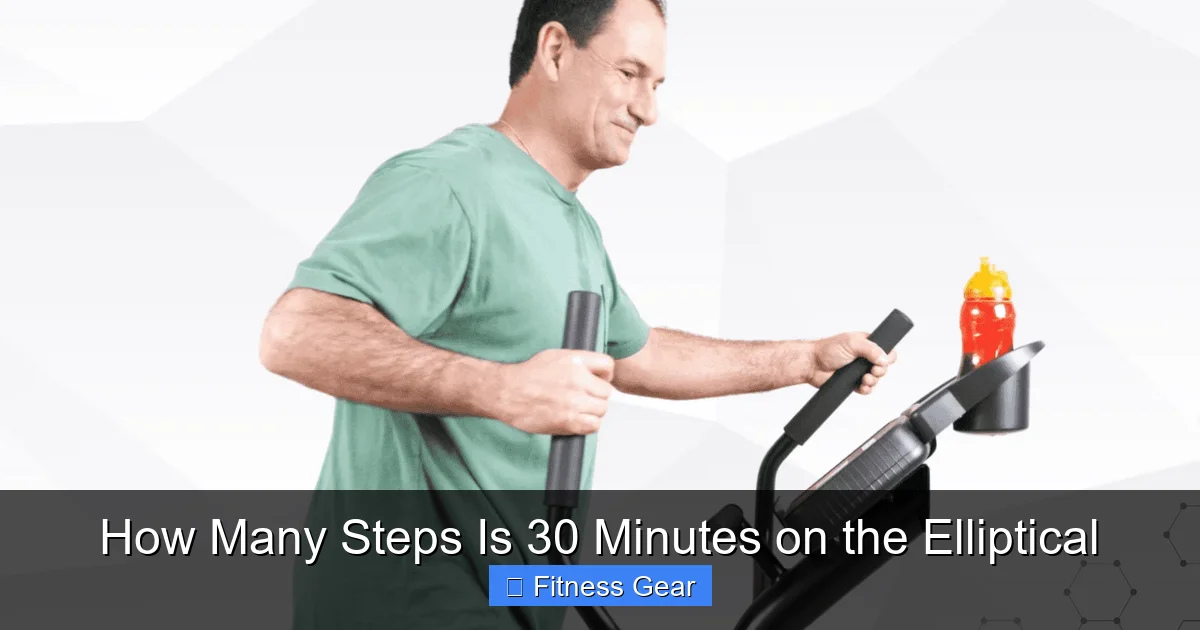
This is the most critical section for setting realistic expectations. Let’s compare a 4,500-step elliptical session to a 4,500-step walk.
Visual guide about How Many Steps Is 30 Minutes on the Elliptical
Image source: fitdominium.com
Distance and Muscle Engagement
An average walking step is roughly 2.5 feet (30 inches) in length for most people. 4,500 walking steps equals about 2.1 miles. On an elliptical with an 18-inch stride, 4,500 steps (revolutions) means your foot traveled 4,500 x 18 inches = 81,000 inches, or 1.28 miles. You’ve “stepped” more times, but your feet have traveled a significantly shorter distance in terms of ground covered. Furthermore, the elliptical is a weight-bearing, low-impact exercise that heavily engages your quads, glutes, hamstrings, and even your upper body if you’re using the arm pivots. Walking is also weight-bearing but engages calves and stabilizers differently. The physiological demand is not equivalent. You cannot say, “I did 4,500 elliptical steps, so I got the same benefit as a 2.1-mile walk.” The energy systems used, the joint stress, and the muscle groups activated are different.
The Calorie Burn Reality Check
Because of the engaged upper body and the constant, smooth resistance, a 30-minute elliptical session at moderate effort for a 155-pound person burns approximately 335 calories. A 2.1-mile walk at 3.5 mph for the same person burns about 150 calories. So, your 4,500 elliptical “steps” burned over twice as many calories as 4,500 walking steps would have. This proves that the step count is a terrible proxy for work done on the elliptical. The machine’s calorie estimate (while also an estimate) is a far more relevant metric for comparing effort and potential weight management impact.
What You Should *Really* Track on the Elliptical (Instead of Steps)
If step count is a misleading metric, what should you focus on to ensure you’re getting a quality workout? Here are the four pillars of effective elliptical training:
- 1. Time: For general health, the gold standard is 150 minutes of moderate aerobic activity per week. Your 30-minute sessions are a perfect building block. Just get the time in consistently.
- 2. Intensity (Perceived Exertion or Heart Rate): This is paramount. Use the “Talk Test” (can you speak in full sentences? That’s moderate. Can you only say a few words? That’s vigorous). Better yet, use a heart rate monitor. Aim for 60-80% of your max heart rate for cardio benefits. Your elliptical’s ” watts” or “METs” readout can also guide intensity.
- 3. Calories Burned (with a grain of salt): While not perfectly accurate, the machine’s calorie readout is a consistent *relative* measure for *you*. If you burned 300 calories today and 320 next week on the same program, you know you worked harder. Use it as a personal benchmark, not an absolute truth.
- 4. Program Variety and Progression: Are you just doing the same flat, easy program every day? That leads to plateaus. Use the elliptical’s pre-set programs (interval, hill, climb) that automatically vary resistance and simulate terrain. This challenges your body in new ways, burns more calories, and builds more muscle than a static workout.
How to Maximize Your 30-Minute Elliptical Workout for Real Results
Now that we know step count is a distraction, let’s build the perfect 30-minute session. Here is a sample, adaptable framework that prioritizes effectiveness over a meaningless number.
The 30-Minute Blueprint: Warm-Up, Work, Cool-Down
Minutes 0-5: Dynamic Warm-Up. Start with low resistance (level 1-2). Focus on smooth, full-range motion. Get your arms involved, pulling and pushing. Gradually increase your RPMs. This prepares joints and muscles.
Minutes 5-25: The Main Set. This is where you choose your adventure. For general fitness, a variable interval program is best. If manually controlling:
- Option A (Cardio Focus): Alternate 3 minutes at a challenging but sustainable pace (RPM 65-75, resistance 5-7) with 2 minutes of active recovery (RPM 55-60, resistance 3-4). Repeat 4 times.
- Option B (Fat Burn/Endurance): Stay in a steady-state “fat burn zone” (often a moderate heart rate zone) for 15-20 minutes. This means a pace where you’re breathing deeply but can still talk in short sentences. It’s sustainable and burns a high percentage of calories from fat.
- Option C (Strength Focus): Use a higher resistance (7-10+) and a slower, more powerful pace (50-60 RPMs). Push through the heels to engage glutes and hamstrings. You’ll likely have a lower step count here, but you’re building muscular endurance.
Minutes 25-30: Cool-Down. Drop the resistance back to 1-2. Continue moving at a comfortable pace to let your heart rate come down gradually. This is crucial for recovery.
Progression is Everything
Your body adapts. If you do the same 30-minute session at the same settings every day for a month, it will become easier, and you’ll burn fewer calories. To keep progressing, you must overload your system. Each week, try one of these: add 1-2 minutes to your main work interval, increase the resistance by 1 level, increase your target RPM by 5, or try a more advanced pre-set program. This ensures you continue to improve cardiovascular fitness, build strength, and burn calories effectively—far superior to chasing a static step count.
The Bottom Line: Stop Counting, Start Achieving
So, how many steps is 30 minutes on the elliptical? The answer lives in the intersection of your machine’s stride length and your chosen pace. It could be 1,500. It could be 2,700. That number alone tells you almost nothing about the quality of your workout. It is a mechanical output, not a measure of fitness. The true value of your 30 minutes is found in the time you dedicated, the sweat you produced, the heart-pumping intensity you achieved, and the consistent habit you are building. An elliptical is a fantastic tool for low-impact cardio, building leg and core strength, and improving endurance. Its metrics—time, distance, calories, heart rate, and watts—are designed to measure *its own* work output. Use those. Let your walking step counter track your steps on solid ground. Don’t force a square peg into a round hole. Embrace the elliptical for what it is: a different, highly effective machine with its own language of progress. Get on, move with purpose for your 30 minutes, and trust the process. Your health and fitness will improve based on the work you put in, not the arbitrary revolution count you accumulate.
Frequently Asked Questions
Is 30 minutes on the elliptical enough for weight loss?
Yes, 30 minutes can be very effective for weight loss when combined with a healthy diet, but consistency and intensity are key. A vigorous 30-minute session can burn 300-450+ calories. Over a week, this significant calorie deficit contributes to fat loss. Focus on increasing intensity or duration gradually to avoid plateaus.
Do elliptical steps count towards my daily 10,000-step goal?
Technically, you can add them, but it’s not recommended. Elliptical steps are mechanically different and typically require less energy per revolution than a walking step. Adding them will inflate your total without providing the same physiological benefit as actual steps. It’s better to track elliptical workouts separately as “cardio minutes” or “elliptical sessions.”
How can I make my elliptical workout more challenging without increasing time?
Increase the resistance level to make each push and pull harder, which builds strength and spikes calorie burn. Alternatively, use interval programs that automatically vary resistance. You can also increase your pace (RPMs) for short bursts. Adding small hand weights (if safe for your machine) or focusing on a powerful drive through your heels are other effective strategies.
What’s a good RPM to aim for on the elliptical?
There’s no single “good” RPM, as it depends on your goal and stride length. For general cardio fitness, aim for 60-80 RPMs. For a strength-focused, power workout, aim for 50-60 RPMs at a high resistance. The key is to find a pace where you can maintain your target intensity for your entire work interval without compromising form.
Why doesn’t my elliptical distance match my running/walking distance?
Elliptical “distance” is a calculated estimate based on your stride length and number of revolutions (steps). It measures the theoretical distance your foot traveled along the machine’s path, not actual ground distance. Because the motion is circular/oval and non-weight-bearing, this number is not comparable to GPS-tracked running or walking distances. It’s best used as a relative measure for that specific machine.
Can I replace all my walking with the elliptical for fitness?
You can, but it’s not ideal to replace *all* weight-bearing activity. The elliptical is superb for cardiovascular fitness and building lower-body muscle with minimal joint stress. However, walking and running provide different bone-strengthening and stabilizer muscle benefits. A balanced fitness plan includes a mix of cardio modalities, strength training, and some weight-bearing activity for bone health. The elliptical is a fantastic primary cardio tool, but variety is still beneficial.