There’s no single “correct” number of miles to ride a stationary bike. Your ideal distance is entirely personal, shaped by your specific fitness goals, current ability, available time, and intensity. Instead of chasing a magic number, focus on consistent, progressive rides tailored to your objectives—whether that’s weight loss, building endurance, or improving heart health. Listen to your body, prioritize form, and use metrics like perceived exertion alongside miles to build a sustainable, effective routine.
Key Takeaways
- Your mileage is personal: There is no universal “right” number of miles; it depends on your unique goals, fitness level, and schedule.
- Goal dictates distance: Weight loss plans differ from endurance training or light cardio for health—each has different optimal mileage and intensity strategies.
- Consistency trumps single-session distance: Riding shorter distances regularly is far more effective than occasional ultra-long, unsustainable sessions.
- Intensity is as crucial as miles: A 5-mile high-intensity ride can be more beneficial than a leisurely 10-mile ride for certain goals like cardiovascular improvement.
- Listen to your body & recover: Overtraining to hit a mileage target leads to injury and burnout. Rest and recovery are non-negotiable parts of any plan.
- Track more than just miles: Combine distance with time, heart rate, perceived exertion, and resistance level for a complete picture of your workout’s effectiveness.
- Progress gradually: Increase your weekly mileage or duration by no more than 10% per week to avoid injury and build endurance safely.
📑 Table of Contents
- So, How Many Miles Should You Actually Ride?
- How Your Primary Goal Shapes Your Ideal Mileage
- The Critical Factors That Change Your “Right” Mileage
- How to Track & Measure Progress (Beyond the Odometer)
- Common Mistakes & How to Avoid Them
- Crafting Your Personalized Weekly Plan: Sample Schedules
- The Final Pedal: Your Miles, Your Rules
So, How Many Miles Should You Actually Ride?
You’ve hopped on the stationary bike, the screen is glowing, and that little odometer is calling your name. You’re ready to pedal, but a big question looms: “How many miles should I aim for?” It’s a simple question that doesn’t have a simple answer. The truth is, the “right” number of miles is as individual as your fingerprint. It’s not about hitting a generic target seen online; it’s about aligning your ride distance with your body, your goals, and your life. This guide will strip away the confusion and give you the tools to determine your perfect, personalized mileage zone.
We’ll move beyond the obsession with the mileage counter and explore how factors like intensity, time, and resistance play just as big a role. Whether you’re a complete beginner or a seasoned cyclist using a bike for cross-training, understanding the “why” behind the distance is what transforms a simple pedal session into a powerful, purposeful workout. Let’s dive in and build your custom stationary bike strategy.
How Your Primary Goal Shapes Your Ideal Mileage
The single biggest factor in determining your target distance is your primary objective. A person training for a century ride has a vastly different plan than someone managing arthritis. Let’s break down the most common goals and the mileage philosophies that serve them best.

Visual guide about How Many Miles Should You Ride a Stationary Bike
Image source: biketoworkday.us
Goal 1: Weight Loss & Calorie Burn
For weight loss, the focus shifts from pure distance to a combination of duration, intensity, and consistency. While you certainly burn calories per mile, a shorter, more intense ride can elevate your metabolism for hours afterward (a phenomenon called EPOC, or Excess Post-exercise Oxygen Consumption).
- Beginner Focus: Start with 20-30 minute sessions. At a moderate pace (12-14 mph on the bike’s display), this might equate to 5-8 miles. The goal is to build the habit and stamina without burnout.
- Intermediate/Advanced Approach: Aim for 30-60 minute sessions. Here, mileage can range widely from 10 to 20+ miles depending on resistance and interval work. A 45-minute ride with HIIT (High-Intensity Interval Training) segments might cover fewer miles than a steady 60-minute endurance ride but will likely torch more total calories.
- Key Strategy: Don’t just chase miles. Incorporate hills (increase resistance) and sprints. A 30-minute ride with 10x 1-minute high-resistance sprints is a powerhouse for fat loss, even if the odometer only reads 6 miles.
Goal 2: General Cardiovascular Health
Major health organizations like the American Heart Association recommend 150 minutes of moderate-intensity aerobic activity or 75 minutes of vigorous activity per week. For stationary biking, this is your foundational benchmark.
- Moderate Intensity (Can talk, but not sing): This typically translates to 3-5 sessions per week of 30-50 minutes each. In this zone, you might cover 8-15 miles per session.
- Vigorous Intensity (Can only say a few words): You can achieve the weekly goal in 3-4 sessions of 25-40 minutes. Due to higher speed/resistance, your per-session mileage might be similar to moderate sessions (7-12 miles), but the cardiovascular challenge is greater.
- Key Strategy: Use a heart rate monitor. Aim for 50-70% of your max heart rate for moderate, 70-85% for vigorous. This ensures you’re training your heart effectively, regardless of the exact miles logged.
Goal 3: Building Endurance & Training for Events
If you’re training for a road bike race, a long-distance charity ride, or simply want to dramatically improve your stamina, your mileage will systematically increase over time. The principle of “specificity” applies—you need to ride enough miles to prepare your body for the demands of long efforts.
- Base Building Phase: Focus on long, steady rides at a comfortable pace. Your longest weekly ride might start at 15-20 miles and gradually increase by 10% weekly.
- Peak Training: Your key long ride could eventually reach 40-60 miles or more on the stationary bike, simulating the time-on-bike of your goal event.
- Key Strategy: For endurance, time is often a better metric than miles. Aim to complete your long ride in a specific time (e.g., 2 hours) at a steady, sustainable pace. The miles will follow.
Goal 4: Rehabilitation, Low-Impact Recovery, or Mobility
Here, the objective is movement without stress. Mileage is minimal and secondary to gentle motion, range of motion, and blood flow.
- Typical Range: 5-10 minutes to start, possibly building to 15-20 minutes. In that time, you might cover only 2-5 miles at a very low resistance.
- Key Strategy: Use the bike as a “warm-up” or “cool-down” tool. Focus on smooth, full-range pedal strokes. The goal is to lubricate joints and increase circulation, not to set a speed record. Zero pain is the rule.
The Critical Factors That Change Your “Right” Mileage
Even with a clear goal, your ideal distance floats based on several daily and personal variables. Ignoring these can lead to frustration or injury.

Visual guide about How Many Miles Should You Ride a Stationary Bike
Image source: bikeaton.com
Your Current Fitness Level & Experience
A novice and an experienced cyclist will have completely different responses to a “10-mile ride.” For the beginner, that might be a maximum effort leaving them breathless. For the veteran, it’s a casual warm-up. Always benchmark from your own current ability. Start where you are. If 5 miles feels hard, that’s your starting point. Progress from there. A great rule is the “talk test”—if you can’t speak in full sentences during your ride, you’re likely in a good training zone for improvement, but if you’re gasping after 2 miles, you’ve started too hard.
Intensity & Resistance: The Mileage Illusion
This is the most important concept: A mile at high resistance is not the same as a mile at low resistance. You could ride 15 “miles” at a snail’s pace on level 1 and get a minimal workout. Conversely, 8 miles with frequent hill climbs (high resistance) is a brutally effective strength and cardio session. The bike’s mileage counter doesn’t know the difference. You must account for it. A more useful metric is “Total Work,” which combines speed, resistance, and time. Many modern bikes and apps estimate this in watts or calories.
Your Available Time
Life dictates the workout. On a busy day, a fierce 20-minute, 5-mile HIIT session is infinitely better than skipping a planned 45-minute, 12-mile ride because you “didn’t have time.” Design your mileage around your schedule. High-intensity, shorter-duration workouts are a fantastic tool for those with limited time. On days with more freedom, you can focus on longer, steady miles.
Recovery Ability & Overall Fatigue
Are you well-rested? Stressed from work? Sore from yesterday’s leg day? Your body’s readiness changes daily. On low-energy days, it’s wise to swap a planned 15-mile endurance ride for a gentle 5-mile active recovery spin. Forcing high mileage when fatigued is a direct ticket to overuse injuries like tendonitis or stress fractures. Your mileage plan must be flexible.
How to Track & Measure Progress (Beyond the Odometer)
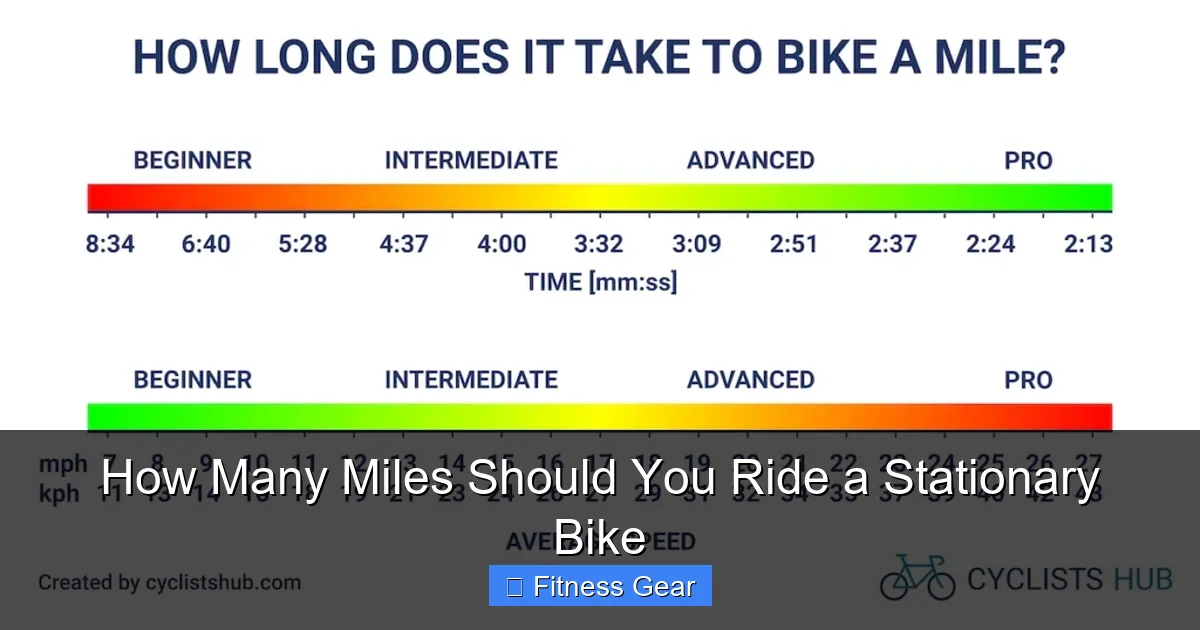
Relying solely on the distance number is like judging a meal only by the plate size. You need a fuller picture. Here’s what to track and why.
Visual guide about How Many Miles Should You Ride a Stationary Bike
Image source: cyclistshub.com
Time Is Your Most Honest Metric
“I rode for 45 minutes” is a complete, uncheatable statement. It doesn’t matter if you covered 8 miles or 12—45 minutes of consistent effort is 45 minutes. For general health and weight loss, time is often a more reliable and less frustrating metric than distance. Set a timer, not a mileage goal.
Perceived Exertion (RPE) – Your Built-In Monitor
The Rate of Perceived Exertion (RPE) scale from 1-10 is a powerful tool. A ride at RPE 3-4 is easy recovery. RPE 5-6 is moderate, sustainable cardio. RPE 7-8 is hard, where talking is difficult. RPE 9-10 is all-out, short bursts. Your goal should be to spend the majority of your weekly ride time in the RPE zones appropriate for your goal. This automatically adjusts your effective “work” for the day, regardless of miles.
Heart Rate – The Objective Data
A heart rate monitor (chest strap or optical sensor) gives you concrete data. Calculate your approximate max heart rate (220 – your age). Then:
- Fat-Burning Zone: ~60-70% of max HR. Good for longer, steady rides.
- Aerobic/Cardio Zone: ~70-80% of max HR. Ideal for improving cardiovascular fitness.
- Anaerobic Zone: ~80-90%+ of max HR. For HIIT intervals and performance gains.
Aim to spend your target time in these zones. A 10-mile ride at 75% HR is a different (and likely better) workout than a 15-mile ride at 60% HR.
Resistance Level & Watts
Note your average resistance level or, if your bike provides it, average watts (power output). Watts are the gold standard as they measure actual work done, factoring in both speed and resistance. If your average watts increase over a month while your time stays the same, you’re getting stronger and fitter—even if your miles dip slightly because you’re pushing harder against more resistance.
Common Mistakes & How to Avoid Them
Let’s steer clear of the pitfalls that sabotage progress.
Mistake 1: The “Mileage or Bust” Mentality
This is the #1 error. You had a plan for 12 miles, but you feel great at 8. Do you push through to 12? Sometimes, yes, if you feel strong. But if you’re tired, pushing to a arbitrary number leads to poor form, joint strain, and excessive fatigue. The workout’s quality matters more than hitting an exact distance. Be willing to adjust based on how you feel.
Mistake 2: Ignoring Resistance and Chasing Speed
Cranking the pedals like a hummingbird on level 1 resistance gives you a false sense of accomplishment. You cover “miles,” but you’re building minimal strength or calorie burn. Always introduce resistance. Even a moderate ride should have you feeling like you’re pushing against something. A good rule: if you can maintain a conversation easily with no breathlessness at your current speed, add resistance.
Mistake 3: No Progression
Doing the exact same 5 miles at the same resistance for months leads to a plateau. Your body adapts and stops improving. You must progressively overload. This means gradually increasing one variable: add 5 minutes to your time, increase resistance by 1 level, add a short sprint interval, or aim to cover the same distance in less time. A 10% weekly increase in time or distance is a safe guideline.
Mistake 4: Neglecting Warm-Ups and Cool-Downs
Jumping from zero to high resistance is hard on cold muscles and joints. Always start with 5-10 minutes of very easy pedaling (RPE 2-3) to increase blood flow. Similarly, finish with 5 minutes of easy spinning to let your heart rate come down gradually and flush metabolites. These 10 minutes total protect you from injury and soreness.
Crafting Your Personalized Weekly Plan: Sample Schedules
Let’s put it all together. Here are sample weekly structures for different profiles. Remember, these are templates—adjust based on your feel.
Sample Plan A: The Busy Beginner (Weight Loss & Health Focus)
- Monday: 25-minute HIIT ride. Warm-up 5 min easy. Then: 8 rounds of 30 sec sprint (high resistance, RPE 8-9), 90 sec easy recovery. Cool-down 5 min. (~5-6 miles)
- Wednesday: 30-minute steady-state ride. Maintain a moderate, consistent resistance where you can talk in short sentences (RPE 5-6). Aim for a steady pace. (~7-9 miles)
- Friday: Repeat Monday’s HIIT ride.
- Saturday: 40-minute longer, steady ride at a comfortable pace (RPE 4-5). This builds aerobic base. (~10-12 miles)
- Total Weekly Time: ~135 minutes. Total Approx. Miles: 30-40. Focus: Consistency and intensity variation.
Sample Plan B: The Intermediate Fitness Enthusiast (Cardio & Strength)
- Tuesday: 45-minute “pyramid” ride. Warm-up 10 min. Then: 5 min at RPE 5, 4 min at RPE 6, 3 min at RPE 7, 2 min at RPE 8, 1 min at RPE 9, then reverse back down. Cool-down 10 min. (~12-15 miles)
- Thursday: 30-minute high-resistance climb simulation. Keep RPMs (revolutions per minute) between 60-70, and resistance high enough that you’re pushing hard (RPE 7-8). (~6-8 miles, but huge strength benefit)
- Saturday: 60-minute long, steady endurance ride at a conversational pace (RPE 4-5). This is your key ride for building stamina. (~18-22 miles)
- Total Weekly Time: ~135 minutes. Total Approx. Miles: 36-45. Focus: Mix of intensity, strength, and endurance.
Sample Plan C: The Active Recovery & Mobility Focus
- Daily: 10-15 minutes of very light pedaling (RPE 2). Resistance at 1-2. Goal is to move joints, increase blood flow, and not break a sweat. You might cover only 2-4 miles per session.
- Frequency: Can be done daily or on most days, especially after strength training or on rest days from harder cardio.
- Focus: Movement for healing, not fitness. Zero pressure on distance or speed.
The Final Pedal: Your Miles, Your Rules
So, how many miles should you ride a stationary bike? The definitive answer is: enough to meet your goal consistently, without compromising form or recovery. For some, that’s 5 miles in 20 minutes of fierce intervals. For others, it’s 20 miles in a calm hour. The magic is not in the number on the screen, but in the intention behind the ride. Start with the guidelines above for your goal, listen intently to your body’s feedback, and use the richer metrics of time, heart rate, and perceived exertion to guide you. Lace up your sneakers, hop on that saddle, and make every revolution count toward your version of a healthier, stronger you. The perfect mileage is the one that gets you back on the bike, day after day, for the long ride ahead.
Frequently Asked Questions
Is it better to ride for distance or for time?
For most general fitness and weight loss goals, time is a more reliable and flexible metric. Focusing on “30 minutes of effort” ensures you get a consistent workout regardless of daily fluctuations in speed or resistance. Distance is best used as a progress tracker (e.g., “I’m covering more ground in the same 30 minutes”).
How many miles on a stationary bike equals a real bike mile?
There’s no direct 1:1 conversion. Stationary bike miles depend entirely on the bike’s calibration and your resistance. A mile on a low-resistance spin bike feels very different from a mile on a high-resistance recumbent bike. Don’t compare stationary miles to outdoor cycling miles; judge your effort by time, heart rate, and perceived exertion instead.
Can I ride my stationary bike every day?
Yes, but with a crucial caveat: your daily rides must vary in intensity and duration. You can do a gentle 15-20 minute recovery spin daily, but you should not perform hard, high-mileage, or high-intensity rides every single day. Your body needs days of lower stress to repair and get stronger. A good pattern is 3-4 hard days, 1-2 easy/recovery days, and 1-2 full rest days.
What is a good average speed on a stationary bike?
A good average speed for a moderate, sustainable effort is typically between 12-15 mph (19-24 km/h) on most upright or recumbent bikes. However, this is highly variable. A HIIT session will have much higher average speeds during sprints. A very strong cyclist might average 18+ mph. Focus less on the speed number and more on how that speed feels relative to your resistance level (RPE).
How many calories do you burn per mile on a stationary bike?
Calorie burn per mile is not fixed. A lighter person burns fewer calories per mile than a heavier person. More importantly, a mile ridden at high resistance burns significantly more calories than a mile at low resistance. Instead of calculating “calories per mile,” estimate total calories burned for your entire session using a heart rate monitor or the bike’s estimator, understanding these are rough approximations.
Is stationary biking good for knee health?
Yes, stationary biking is generally an excellent, low-impact exercise for knee health when done correctly. It strengthens the muscles surrounding the knee (quadriceps, hamstrings) without pounding joint stress. The key is to ensure proper bike fit (slight knee bend at the bottom of the pedal stroke) and to avoid riding with the resistance set so high that you feel grinding or sharp pain in the knee. If you have pre-existing knee issues, consult a physical therapist for a tailored plan.