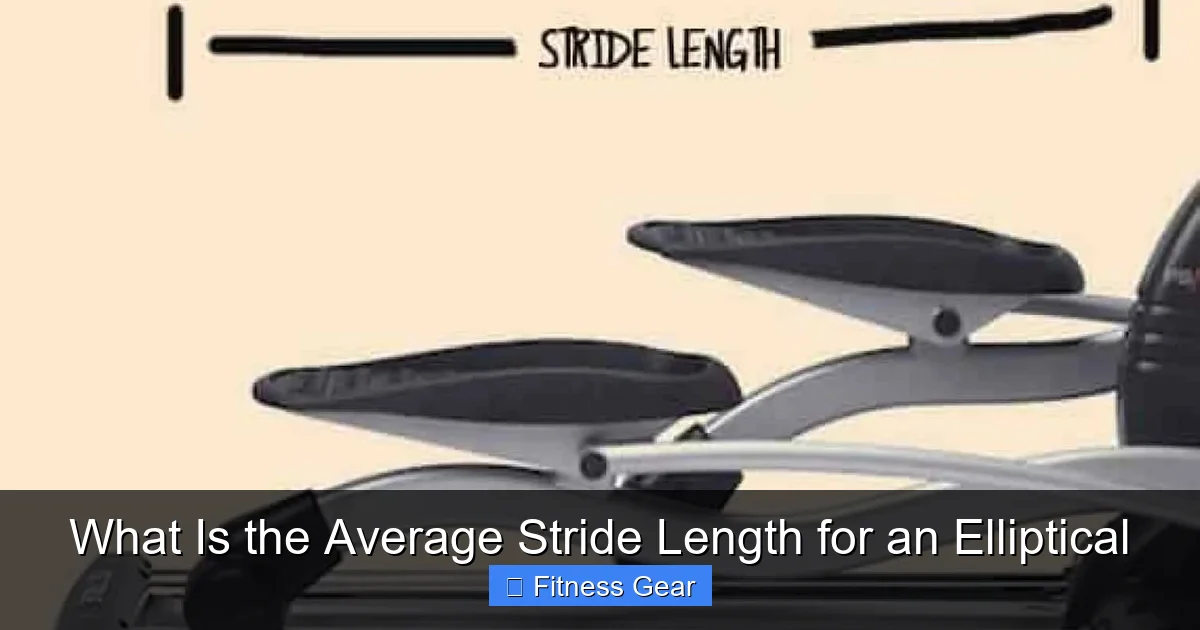
Stride length on an elliptical is the distance your feet travel from front to back during one full pedal revolution. It’s a critical but often overlooked spec that directly impacts workout comfort, effectiveness, and safety. The average stride length ranges from 14 to 22 inches, with 16-20 inches being most common for home models. Your ideal stride is primarily determined by your height and natural walking gait, not the machine’s advertised “average.” Choosing an elliptical with a stride length that matches your body prevents strain, maximizes muscle engagement, and makes your cardio sessions more enjoyable.
Key Takeaways
- Stride length is the single most important fit factor: It determines the naturalness of your motion. A mismatched stride causes hip, knee, or lower back discomfort and reduces workout efficiency.
- Average ranges from 14″ to 22″: Compact/desk ellipticals start around 14″, standard home models are typically 16″-20″, and commercial-grade machines often offer 20″-22″ or even adjustable strides.
- Your height is the primary starting point: A general rule is your stride length (in inches) should be roughly 35-40% of your height in inches. For example, a 5’10” (70″) person likely needs a 24.5″-28″ *natural gait* stride, but elliptical geometry means a 20″-22″ machine stride often feels correct.
- Demo before you buy: The only way to know if a stride length is right for you is to test the machine. Your motion should feel smooth, full, and without any stretching or cramping at the extreme ends of the pedal path.
- Adjustable stride is a premium feature: Some high-end ellipticals allow you to change the stride length, accommodating multiple users or letting you vary your workout intensity and muscle focus.
- Longer isn’t always better: An excessively long stride for your body forces over-extension, increases joint stress, and can make the workout feel awkward and inefficient.
- Elliptical design affects perceived stride: Front-drive, rear-drive, and center-drive machines with the same measured stride length can feel different due to pedal path geometry and the machine’s center of gravity.
📑 Table of Contents
- Why Stride Length Matters More Than You Think
- The Biomechanics Behind the Stride
- Decoding the Market: Elliptical Types & Their Typical Strides
- How to Find Your Ideal Stride Length: A Practical Guide
- Buying Guide: Matching Stride to Your Needs
- Common Mistakes and Misconceptions
- Unlocking the Benefits: What the Right Stride Length Gets You
- Conclusion: Your Perfect Stride Awaits
Why Stride Length Matters More Than You Think
You’re standing in the store or browsing online, comparing ellipticals. You look at resistance levels, programs, warranty, and screen size. But one spec, often listed in small print, holds the key to your long-term satisfaction or your nagging joint pain: stride length. It’s not just a number; it’s the fundamental measurement of how the machine moves with you.
Think about walking or running. Your stride—the distance your foot travels from heel-strike to the next heel-strike—is uniquely yours. It’s dictated by your leg length, flexibility, and neuromuscular patterns. An elliptical tries to replicate that smooth, oval motion. If the machine’s stride length forces your legs into a shorter or longer path than your body naturally wants to go, you’ll feel it. Your hips might ache. Your knees might click. Your lower back might tighten up. You’ll either push through the discomfort, risking injury, or you’ll quit using the machine altogether. Understanding stride length is the first step toward buying an elliptical that feels like it was made for your body, not the other way around.
The Biomechanics Behind the Stride
To truly grasp stride length, we need to peek under the hood at the biomechanics. An elliptical’s stride length is the linear distance the pedal travels from its most forward position to its most rearward position during one full revolution. It’s measured in inches. But crucially, this is not the same as your natural walking or running stride on the ground.
Visual guide about What Is the Average Stride Length for an Elliptical
Image source: ellipticalhub.com
The Elliptical Path vs. Your Natural Gait
On solid ground, your stride is a complex interaction of gravity, ground reaction forces, and the push-off from your toes. The elliptical path is a constrained, fixed oval. Your foot is locked into a pedal, and your motion is dictated by the machine’s linkage system. This means your body must adapt to the machine’s geometry. A well-designed elliptical with an appropriate stride length allows this adaptation to be seamless. Your hips, knees, and ankles move through a range of motion that feels natural and fluid. A poor match creates a “choppy” motion, where you feel yourself being pulled at the end of the stride or have to actively push to complete the arc.
Joint Health and Muscle Engagement
The right stride length promotes a full, smooth range of motion at the hip and knee. This full engagement is what activates more muscle groups—glutes, hamstrings, quads, calves—more effectively than a shorter, cramped motion. It also distributes the workload evenly, preventing overuse of specific joints. Conversely, a stride that’s too short keeps your knees bent deeply throughout, increasing compressive force on the patella. A stride that’s too long forces your leg into hyperextension at the back of the movement, straining the hamstrings and lower back. The “average” stride is a myth because your joints’ ideal range of motion is personal.
Decoding the Market: Elliptical Types & Their Typical Strides
Not all ellipticals are created equal, and their design heavily influences the standard stride length you’ll find. The three main drive system configurations—front-drive, rear-drive, and center-drive—each have characteristic stride profiles.

Visual guide about What Is the Average Stride Length for an Elliptical
Image source: garagegympro.com
Front-Drive Ellipticals
These are the classic, heavy-duty commercial machines you see in gyms, with the large flywheel and mechanism at the front. They typically offer the longest stride lengths, often 20″ to 22″ or more. The pedal path is long and smooth, closely mimicking a running gait. This makes them excellent for taller users and those wanting a powerful, full-bodied workout. Home versions of front-drive designs also tend to have longer strides, often 18″-20″.
Rear-Drive Ellipticals
Popularized by brands like NordicTrack and ProForm, the mechanism is at the rear. This design often creates a slightly shorter, more compact pedal path for a given machine measurement. You’ll commonly find 16″ to 18″ stride lengths on consumer rear-drive models. The motion can feel more like a steep climb or a fast walk. They are often more affordable and space-efficient but may feel cramped for users over 6’0″.
Center-Drive Ellipticals
A newer design where the drive system is centered beneath the user. This creates a very balanced, low-impact motion with a stride length that can feel quite natural and upright. Strides here vary widely but often fall in the 16″-20″ range. They are prized for their smoothness and smaller footprint. The perceived stride can be different from the measured length due to the unique pedal path geometry.
The Takeaway: Don’t compare stride lengths across different drive types as a direct 1:1 equivalent. A 20″ stride on a front-drive will feel longer and more natural to a tall person than a 20″ stride on some rear-drive models. Always, always demo the specific machine.
How to Find Your Ideal Stride Length: A Practical Guide
So, what’s the magic number for you? While there’s no substitute for testing, we can get dangerously close with some simple calculations and self-assessment.
Visual guide about What Is the Average Stride Length for an Elliptical
Image source: boxlifemagazine.com
The Height-Based Rule of Thumb
A widely cited starting point in the industry is to take your height in inches and multiply it by 0.35 to 0.40. This estimates your natural, comfortable walking stride length on the ground.
- Example (5’4″ / 64″): 64″ x 0.35 = 22.4″ | 64″ x 0.40 = 25.6″. This suggests a natural gait stride in the low-to-mid 20s. However, most home ellipticals max out around 20″. Does this mean a shorter person is out of luck? No. It means the elliptical’s geometry will “scale down” that natural feeling. A 5’4″ user will typically feel best on a 16″-18″ elliptical stride.
- Example (6’2″ / 74″): 74″ x 0.35 = 25.9″ | 74″ x 0.40 = 29.6″. This clearly points toward needing a 20″-22″+ machine stride to feel open and natural, steering them toward front-drive or commercial models.
Important: This is a starting estimate. Flexibility, hip mobility, and personal preference play huge roles.
The Demo Test: Your Non-Negotiable Checklist
You must physically use the elliptical. Here’s what to feel for:
- Start Slow: Begin at the lowest resistance. Focus solely on the motion of your legs.
- The Full Arc: At the front of the stride, does your knee feel like it’s about to hit your chest? It shouldn’t. At the back, can you fully extend your leg without locking your knee or feeling a sharp pull in your hamstring? You should be able to achieve a near-full extension comfortably.
- Hip and Pelvis: Your hips should rock gently with the motion. There should be no grinding, pinching, or excessive twisting in your hip flexors at the front of the stride.
- Posture: Can you maintain a proud chest, relaxed shoulders, and a neutral spine without leaning forward or backward to “complete” the stride? If you have to contort your upper body, the stride is wrong.
- Cadence Comfort: Find a natural, comfortable stepping rhythm. Does it feel forced or jerky? A good stride length allows for a smooth, continuous circle.
Adjustability: The Golden Ticket
If your household has multiple users of significantly different heights (e.g., 5’2″ and 6’4″), an elliptical with an adjustable stride length is worth its weight in gold. This feature, found on higher-end models, usually involves moving a pin or turning a dial to change the pivot point of the pedal linkage, effectively shortening or lengthening the arc. It adds cost and complexity but is the ultimate solution for a shared machine. If this is your situation, prioritize this feature above almost all else.
Buying Guide: Matching Stride to Your Needs
Armed with self-knowledge, let’s translate that into a smart purchase. Your intended use and user profile are critical.
For the Tall User (6’0″ and above)
You are the group most punished by a short stride. Look for a minimum of 20″, with 21″-22″ being ideal. Front-drive commercial-style or high-end center-drive models are your best bets. Be wary of compact or rear-drive models advertising “space-saving” designs; their stride lengths are often the first thing sacrificed. Test rigorously. Your goal is to feel open, not cramped.
For the Average/Short User (Under 5’10”)
You have the widest range of suitable machines. A 16″-18″ stride is often perfect. Many excellent rear-drive and center-drive home models sit in this range. The danger here is not a stride that’s too long, but one that is poorly designed and feels “choppy” despite a nominal 18″ measurement. The demo test is still vital. A smooth 16″ can be far superior to a jarring 18″.
For Low-Impact Rehabilitation or Seniors
The priority is minimal joint stress and a controlled, comfortable motion. A slightly shorter stride (15″-17″) can sometimes provide a more stable, less demanding range of motion. However, it must still allow for a full, pain-free extension. Look for machines with an exceptionally smooth, quiet resistance system and a stable, unwavering frame. The feeling of security is as important as the stride measurement.
Space vs. Stride: The Trade-Off
You’ll see ellipticals advertised with tiny footprints. Understand that a very short machine (under 5 feet long) almost certainly has a compromised stride length, often under 16″. The linkage system simply doesn’t have the room to create a long, smooth arc. If space is your primary constraint, you must accept a shorter stride. If stride length is your priority, you must accept a larger floor space requirement. There is no free lunch in elliptical engineering.
Common Mistakes and Misconceptions
Even with the best information, pitfalls remain. Here are the myths we need to bust.
Myth 1: “The Longer the Stride, the Better the Workout.”
This is the most dangerous fallacy. A longer stride only provides a better workout if it matches your body. An 18″ user forced onto a 22″ machine will have a terrible, inefficient workout. They’ll use accessory muscles to compensate, fatigue faster, and likely quit. A 16″ stride executed with full range and good resistance can provide a superior workout to a poorly matched 20″ stride.
Myth 2: “Stride Length is the Same as Machine Length.”
Absolutely not. A 6-foot-long elliptical could have a 16″ stride if the design is inefficient. A 5.5-foot machine could have a 20″ stride if it’s a well-engineered front-drive model. Never infer stride from overall dimensions. The spec sheet must list it.
Myth 3: “I Can Just Adjust My Body to Fit the Machine.”
You can adapt slightly, but you cannot overcome fundamental geometry. Your bones and joints have set lengths. If the machine’s arc is too short, you will be in a perpetual, deep squat. If it’s too long, you will hyperextend. Your body will not “get used to it” in a healthy way; it will develop compensatory patterns and pain.
Ignoring the Pedal Path Shape
Some ellipticals have a more “rounded” path, while others are more “flattened” or even have a slight hump. This affects where you feel the resistance. A flattened path might feel more like a treadmill, while a rounded path emphasizes the up-and-down climbing motion. Two machines with identical stride lengths can feel worlds apart due to this subtle difference in path geometry. This is why the demo is irreplaceable.
Unlocking the Benefits: What the Right Stride Length Gets You
When you find that magical match between your body and the machine’s stride, the benefits cascade.
Optimal Muscle Recruitment
A proper stride allows for a full hip extension, powerfully engaging your gluteus maximus—the largest muscle in your body. It also allows for a deep knee bend and full quadriceps engagement on the front part of the stride and a strong hamstring contraction on the back. You get a true full-body, lower-body workout in every single revolution.
True Low-Impact Motion
The whole point of an elliptical is to eliminate the pounding of running. A correct stride length ensures your feet stay in constant, flat contact with the pedals, and the motion is a smooth, continuous circle. There are no jarring transitions from heel-strike to toe-off. Your knees, ankles, and hips experience minimal shear and compressive forces, making it ideal for injury recovery, arthritis sufferers, and anyone wanting to protect their joints while getting a serious cardio session.
Sustained Comfort and Consistency
This is the big one. When the motion feels natural, you forget about the machine. You can watch TV, read a book, or simply zone in on your breathing. There’s no nagging ache in your hip flexors, no tightness in your calves. This comfort translates directly to adherence. You’ll use the machine more often, for longer durations, and for years to come. That is the ultimate ROI on your fitness equipment purchase.
Conclusion: Your Perfect Stride Awaits
The search for the “average stride length for an elliptical” is a search for a starting point, not a destination. That average—somewhere between 16 and 20 inches—is a statistical midpoint that means nothing to you as an individual. Your perfect stride is a conversation between your body’s unique geometry and the machine’s engineering. It is found not in a spec sheet, but on the showroom floor, in your living room during a trial period, or through the adjustable dial of a premium model.
Commit to the process. Measure your height, use the rule of thumb, but then go test. Put on your workout shoes and spend 10 minutes moving on three different ellipticals with different stride lengths. Feel the difference. Listen to your body. It will tell you which stride feels like home. Investing this time upfront guarantees you buy an elliptical that becomes a cherished, effective, and pain-free partner in your health journey for a decade or more. Don’t just buy an elliptical; find the one that fits you.
Frequently Asked Questions
Does a longer stride length on an elliptical burn more calories?
Not inherently. Calorie burn is primarily driven by workout intensity (resistance and speed) and your body weight. A longer stride only burns more calories if it allows you to work out more comfortably and for a longer duration, or if it enables you to push against higher resistance effectively. A mismatched long stride will likely lead to poor form and early fatigue, reducing overall calorie expenditure.
How do I know if my elliptical’s stride length is too short for me?
>Key signs include: feeling like you’re “running in place” with minimal leg extension, your knees feeling crowded or hitting your torso at the front of the motion, and an inability to fully straighten your leg at the back of the stroke without locking your knee or straining your hamstring. You may also feel your hips rocking excessively or your lower back working too hard.
Is there a significant difference in stride length between commercial and home ellipticals?
>Yes, typically. Commercial-grade front-drive ellipticals almost always have longer stride lengths (20″-22″+), as they are built for a wide range of tall users in a gym setting. Home models, especially space-saving rear-drive designs, often have shorter strides (16″-18″). However, the home market now includes longer-stride front-drive models for serious fitness enthusiasts.
Can a shorter stride length be better for knees or hips?
>For some individuals with specific mobility limitations or extreme tallness, a slightly shorter stride can provide a more stable, controlled range of motion that avoids painful end-ranges. However, the goal is always a *full, pain-free* range of motion. A stride that is too short for your anatomy keeps your knees deeply bent, which can actually increase patellar compression. The “better” stride is the one that allows you to move through your natural, comfortable arc.
What’s the difference between “stride length” and “pedal path”?
>Stride length is the linear measurement (in inches) of the pedal’s travel. The pedal path describes the actual shape of that oval—how rounded, flattened, or angled it is. Two ellipticals can have the same 20″ stride length but feel very different if one has a more circular path and the other has a flatter, more “running” path. The path shape affects muscle emphasis and the overall feel of the motion.
Should I choose an elliptical with an adjustable stride length?
>If multiple people of significantly different heights (more than 6-8 inches) will use the machine regularly, an adjustable stride is a fantastic investment that ensures comfort for everyone. If it’s just for you, the added cost and mechanism may not be necessary if you can find a fixed-stride model that perfectly matches your body through testing.